
There is a moment in endurance sport that nobody warns you about.
You have trained for months. You have sacrificed weekends, early mornings, social events. You have been through conditions that made you question everything. And then, finally, you cross the finish line.
And you wait for the feeling.
Sometimes it comes. That rush of joy, relief, and pride that makes every hard kilometre worth it.
But sometimes, it does not. Sometimes you cross the line, collect your medal, and feel… empty. Like the finish line you worked so hard to reach was not actually the destination you were looking for.
I have crossed enough finish lines, including multiple Ironman triathlons, the Dusi Canoe Marathon, and a 550km tandem bicycle crossing of the Himalayas at over 18,000 feet above sea level, to know that feeling well. And I have spent years working with high-achieving women in corporate environments who describe exactly the same experience.
They get the promotion. They hit the target. They lead the team. They build the career. And somewhere in the middle of achieving everything they said they wanted, they quietly start to fall apart.
That is not a failure of ambition. That is what happens when you have been chasing a false finish line.
What Is a False Finish Line?
A false finish line is any goal that promises fulfilment but delivers only the next target.
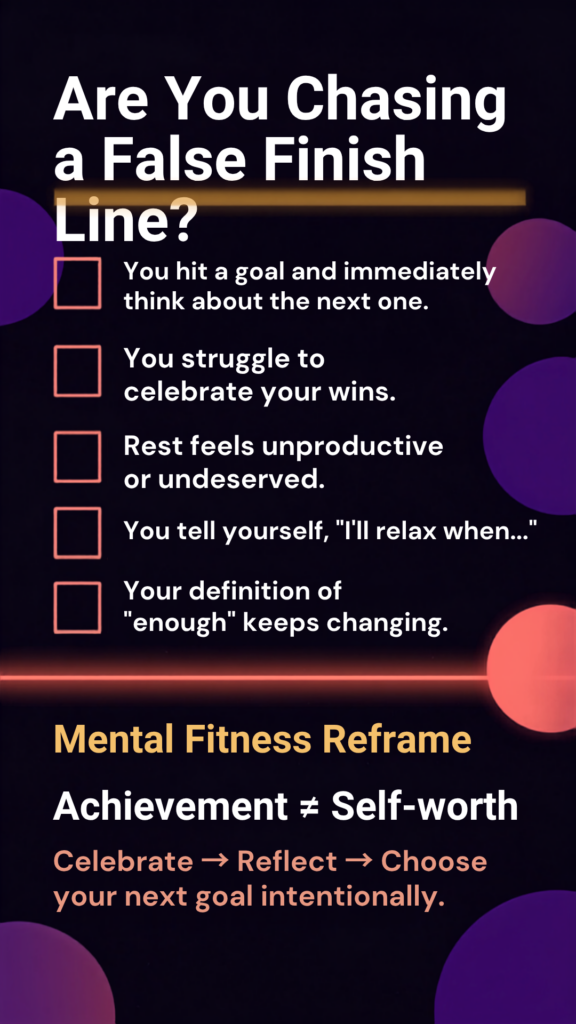
You may recognise the pattern. “Once I get the promotion, I’ll feel settled.” Then, “Once the team is performing, I’ll feel in control.” Then, “Once this project is done, I’ll rest.” The goal posts keep moving. The finish line keeps shifting. And the person running never actually gets to stop.
In neuroscience, this pattern has a name: hedonic adaptation. The brain is wired to return to a baseline level of satisfaction relatively quickly after achieving a goal. The dopamine hit that comes with hitting a milestone is real, but it is also temporary. The brain recalibrates, raises the bar, and the chase begins again.
Neuroscience Insight: Research from the University of California confirms that hedonic adaptation, the tendency to return to a stable level of happiness despite major positive life changes, means that external achievements produce diminishing returns over time. The brain requires novelty and meaning, not just accomplishment, to sustain motivation and wellbeing.
For high-achieving women, the false finish line is particularly dangerous because the culture around them keeps reinforcing it. Push harder. Do more. Be more. The woman who never stops is celebrated. The woman who pauses is questioned.
Until she burns out. And by then, the cost is significant.
The Giraffe in the Room
I use a teaching tool I call The Giraffe.
Imagine a giraffe standing in your office. It is enormous. It takes up the whole room. But if it has been there long enough, you stop seeing it. You navigate around it. You build your routines to accommodate it. Eventually, it just becomes part of the furniture.
That giraffe is chronic stress. That giraffe is the relentless pace. That giraffe is the nagging sense that you are running on empty but cannot afford to stop.
Most high-achieving women I work with have had their giraffe in the room for years. They are so adapted to working under pressure that they have lost the ability to distinguish between performing at their best and operating in survival mode.
The first step is simply being willing to see it.
Why High-Achieving Women Are Most at Risk
Ambition and perfectionism are powerful drivers. They are also, when left unmanaged, significant burnout accelerators.
Research published in the Journal of Occupational Health Psychology found that women in senior roles are significantly more likely than their male counterparts to experience burnout driven by emotional labour, the invisible work of managing other people’s emotions, maintaining relationships, and absorbing the interpersonal friction of a team.
Add to that the internal mental patterns that many high performers carry without recognising them as problems: the relentless inner critic, the tendency to discount achievements, the belief that resting means falling behind.
In the Positive Intelligence framework developed by Dr Shirzad Chamine at Stanford, these patterns are called Saboteurs. They are the mental habits that once helped you survive, and now quietly undermine you. The Hyper-Achiever Saboteur, for example, drives performance through a need for constant achievement and status. It produces excellent results in the short term. Over time, it produces burnout.
The catch is that it feels like a strength right up until it breaks you.
Mental Fitness Tip: When you notice yourself thinking “I’ll rest once this is done,” pause and name it. That thought is not a productivity strategy. It is a Saboteur pattern. The brain that never rests does not perform better. It performs on borrowed time. Schedule recovery the same way you schedule a board meeting. Non-negotiable. Calendared. Protected.
Redefining the Finish Line
Here is what I learned from the Himalayas.
When you are riding a tandem bicycle at altitude, the air is thin, the road is brutal, and the summit feels impossibly far away. You learn very quickly that you cannot spend your energy scanning for the finish line. You have to find the win inside the current kilometre.
That is not a motivational metaphor. It is a neurological strategy.
The brain’s reward system, specifically the dopamine pathways, is activated not only by achieving a goal, but by making progress toward one. Research from Harvard Business School confirms what endurance athletes know intuitively: the perception of forward movement generates motivation and wellbeing, even when the finish line is out of sight. https://hbr.org/2011/05/the-power-of-small-wins
A new definition of success is not about lowering the bar. It is about placing wins at shorter intervals along the route, so the brain stays fuelled for the long race.

A Practical Framework: From False Finish Lines to Sustainable Success
This is the framework I use with coaching clients and in keynote sessions. It is built on neuroscience, endurance sport principles, and the mental fitness tools that actually hold up under pressure.
Step 1: Audit Your Finish Lines Write down your top three current goals. Then ask: “If I achieve this, will I feel like enough?” If the honest answer is “probably not,” you are chasing a false finish line. The goal may still be worth pursuing. But it needs to stop being the thing your worth depends on.
Step 2: Name Your Giraffe What chronic pressure have you normalised? What stress are you working around rather than addressing? Name it specifically. Vague discomfort is harder to manage than a named problem.
Step 3: Identify Your Saboteur Patterns Notice the mental commentary that drives your pace. Is it genuine ambition or fear of not being enough? Curiosity or hypervigilance? Confidence or the need for external validation? You cannot manage what you have not identified.
Step 4: Build Recovery Into the Route Recovery is not a reward for finishing. It is a performance requirement. The brain consolidates learning, processes emotion, and restores executive function during rest. Without it, you are not being resilient. You are depleting a resource you cannot easily replace.
Step 5: Redefine the Win What would it mean to succeed in a way that you can sustain for the next decade? Not just the next quarter. Build that definition deliberately. Then make decisions that are consistent with it.
Sales Team Application: Sales environments are particularly vulnerable to false finish line culture. The quarter ends. A new target appears. The celebration lasts a day. Build intentional recognition rituals that close the loop, acknowledge the effort, and give the brain the neurochemical reward it needs before the next sprint begins. Teams that celebrate milestones meaningfully outperform teams that do not, not because celebration is nice, but because the brain needs the signal that the work counted.
What Real Finish Lines Feel Like

I want to be honest about this.
Some of my most significant finish lines have been quiet. Not the ones with a crowd and a medal. The moment a coaching client says, “I slept through the night for the first time in months.” The first Women’s Day keynote where the audience sat in silence at the end not because they were unmoved, but because they were recognising themselves in what had just been said.
Those are real finish lines. They do not move. They do not demand more.
High-achieving women deserve both. Ambitious goals worth working toward, and the clarity to know when they have genuinely arrived.
That is what a new definition of success looks like. Not smaller dreams. A more honest map.
Key Takeaways
- False finish lines are goals that promise fulfilment but deliver only the next target. They are neurologically driven and culturally reinforced.
- Hedonic adaptation means external achievements produce diminishing returns. The brain needs meaning and progress, not only accomplishment.
- High-achieving women are at elevated burnout risk due to emotional labour, Saboteur mental patterns, and cultures that reward relentlessness.
- The Positive Intelligence framework identifies mental habits like the Hyper-Achiever Saboteur that drive performance at the cost of sustainability.
- Redefining success is not about lowering ambition. It is about placing wins at shorter intervals and building recovery into the route.
- Real finish lines do not move. Learning to recognise them is a skill that can be developed.
Frequently Asked Questions
What is a false finish line in the context of women’s success? A false finish line is a goal that is framed as the destination for fulfilment or rest but which, once achieved, simply shifts to the next target. The pattern is driven by hedonic adaptation in the brain and reinforced by cultures that reward relentless achievement. High-achieving women are particularly vulnerable because their Saboteur patterns, specifically the Hyper-Achiever, keep raising the bar before the previous goal has been genuinely celebrated.
Why do high-achieving women burn out even when they are succeeding? Because the metrics they are using to define success are externally driven and moving targets. Burnout among high performers is rarely caused by hard work alone. It is caused by the absence of genuine recovery, the presence of chronic stress that has been normalised, and the belief that rest must be earned rather than scheduled. The brain simply cannot sustain peak performance without adequate restoration.
What is hedonic adaptation and why does it matter for women leaders? Hedonic adaptation is the brain’s tendency to return to a stable baseline of satisfaction after positive life events. It means that promotions, achievements, and milestones produce a temporary dopamine response, and then the brain recalibrates and demands the next target. For women leaders, understanding this neurological process is important because it reframes the “nothing is ever enough” feeling from a character flaw to a brain pattern that can be managed.
What are Saboteur patterns and how do they affect performance? Saboteurs are mental habits identified in the Positive Intelligence framework that once served a protective function but now undermine performance and wellbeing. The Hyper-Achiever Saboteur, for example, drives people to measure their worth through constant achievement. It can produce strong short-term results while quietly accelerating burnout. Identifying and interrupting Saboteur patterns is a core mental fitness skill.
How can women leaders build sustainable success without sacrificing ambition? By separating achievement from worth, building recovery into their schedule as a non-negotiable, placing meaningful wins at shorter intervals along the route, and developing the self-awareness to distinguish between genuine ambition and fear-driven over-performance. Sustainable success is not about doing less. It is about performing in a way that can be maintained over a decade, not just a quarter.
Who is Liezel van der Westhuizen? Liezel van der Westhuizen is a South African Mental Fitness and Burnout Prevention Coach, keynote speaker, neuroscience coach, certified hypnotherapist, and professional master of ceremonies with over 2,000 events hosted globally. She holds a Master’s in Business Communication and a BCom in Human Resources and Industrial Psychology from the University of Pretoria. A former television and radio presenter and endurance athlete, she became the first South African all-female blind and sighted pair to complete a tandem bicycle crossing of the Himalayas. She works with corporate leaders, executives, and high-performing sales teams to help them hit ambitious targets without burning out.
ABOUT THE AUTHOR
Liezel van der Westhuizen is South Africa’s leading burnout coach, mental fitness coach for sales teams, and keynote speaker, known as The Giraffe. She holds a Master’s Degree in Business Communication and is a certified Neuroscience Coach and Positive Intelligence practitioner as well as a Hypnotherapist , Based in Cape Town and working globally, she helps leaders and high-performing teams hit ambitious targets without burning out. She is also a radio and TV presenter.


